Ask whether the used-car market is cooling and the answer changes depending on how you measure it. Most of the obvious ways are wrong, and one of them is wrong in a way that hides what is actually happening.
Carify indexes live and recent listings from across the Australian market, a little over 24 million of them. For this we narrowed hard: the same listing sources every month, a fixed basket of 44 mainstream nameplates, and one build year held constant. That last part does the heavy lifting. Track "the median used car" and the number falls every month simply because cars age, then jumps every January when the cohort rolls over. Follow the same 2021-build cars month after month and every movement you see is the market moving.
Six flat months, then April
Here is what those cars did.
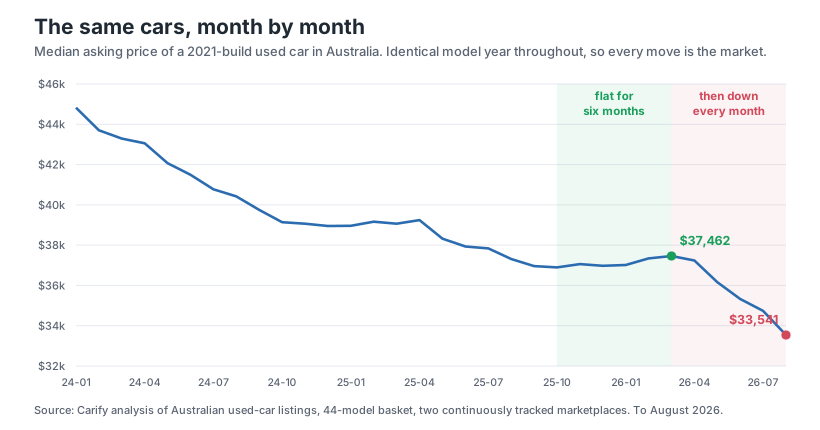
Through 2024 the fall was relentless. By January 2025 a 2021 car was asking 13 percent less than it had twelve months before. Then it stopped. From October 2025 through March 2026 the index went sideways and even crept up, from $36,897 to $37,462. Six months of nothing. It looked like a floor.
In April it rolled over. May, June, July, August, down every single month and further each time. By August a 2021 car was asking $33,541. That is 10.5 percent off the March figure in five months, on cars that did not change in any way. The year-on-year decline has widened from 4.1 percent in March to 10.1 percent in August, the steepest since February 2025.
So the market is cooling, and we can put a date on it. It turned in April 2026 and it has picked up speed every month since.
Why the sticker price says nothing is wrong
Now the trap. Take the other obvious measure, the asking price of a typical four to six-year-old car, and compare the same weeks this year and last. It comes out at $34,475 against $34,452. Up 0.1 percent. Flat.
That number is real and it is useless. A four to six-year-old car in 2026 is a 2020 to 2022 build. Last year it was a 2019 to 2021 build. Every year the cohort refreshes into slightly newer cars that cost more when they were new, and that upgrade almost exactly cancels out the fall in what any individual car is worth. Near-new asking prices have barely moved in three years: $49,496, then $49,727, then $49,939. The ladder has stayed put. The rungs are dropping.
This is how "used car prices are stable" and "my car is worth six grand less than last winter" end up both being true at once, and it is why we lead with the fixed-cohort figure rather than the headline one.
Not one model in the basket went up
We ran the same 2021-build test on each of the 44 nameplates separately. All 44 fell. Not one held flat, let alone gained.
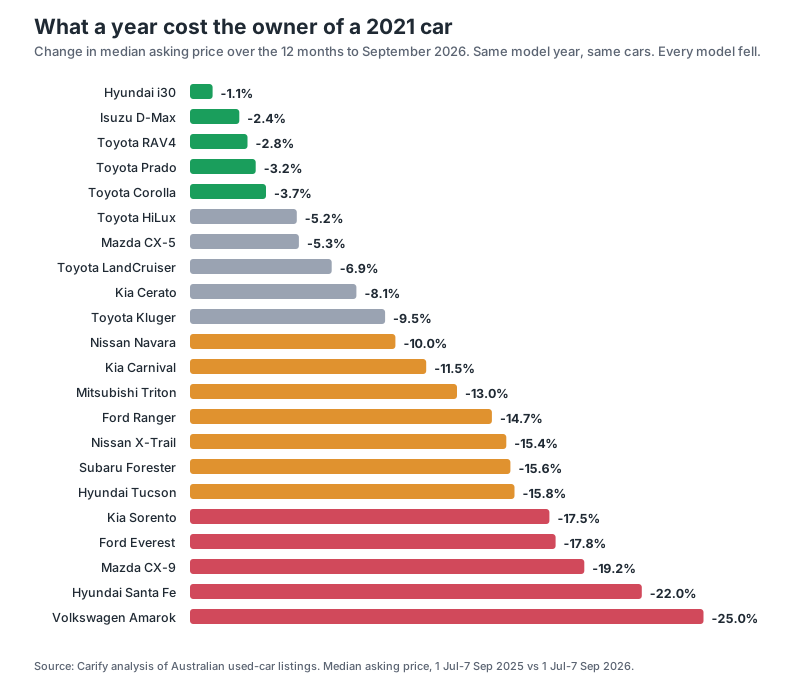
The spread is what matters. A 2021 Hyundai i30 gave up 1.1 percent over the year. A 2021 Volkswagen Amarok gave up 25 percent. The safe end of the table is the boring end: i30, Isuzu D-Max, RAV4, Prado and Corolla all landed inside 4 percent. Those are largely the same names that top our value-retention rankings, and that is the whole point. Cars with deep demand and cheap parts keep selling when the market thins out.
The damage sits in big family SUVs and the dearer utes. Hyundai Santa Fe down 22 percent, Mazda CX-9 down 19.2, Ford Everest down 17.8, Kia Sorento down 17.5, Hyundai Tucson down 15.8. The Ford Ranger is down 14.7 percent. Utes did not move as a bloc either: the D-Max and HiLux held on while the Ranger, Triton and Amarok were taken apart. Anyone who bought a dual-cab near the top and is still holding it has had an expensive year.
The hybrid version of the same car held on
One thing genuinely resisted. Line up the hybrid and petrol versions of the same model, same build year, same weeks, and the hybrid wins every time bar one.
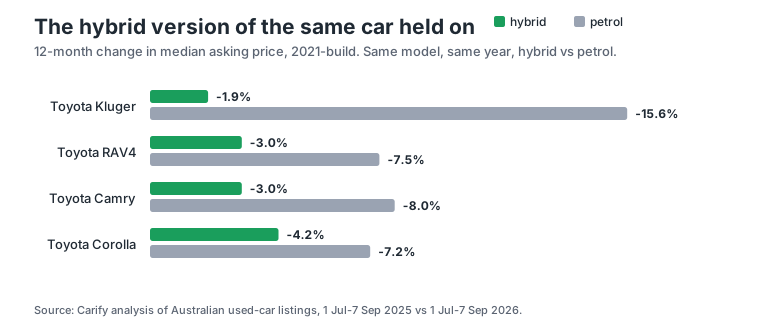
A 2021 Kluger Hybrid lost 1.9 percent. The petrol Kluger lost 15.6. RAV4, 3.0 against 7.5. Camry, 3.0 against 8.0. Corolla, 4.2 against 7.2. The one model that broke the pattern was the C-HR, which is also our thinnest sample of the five, so read it as noise rather than a counter-example.
A gap that wide is not a fuel-price story on its own. Buyers watching a weekly budget want the cheap-to-run version, and there were never enough used hybrids in the country to go round. The Australian Automotive Dealer Association found the same thing from the sales side in its half-year figures: used electric sales up 54.6 percent year on year, while petrol and diesel took the price hit.
Cheaper does not mean cheap
The reasonable hope is that a cooling market finally puts a decent car within reach of someone on a tight budget. It has not happened yet.
In 2021, 18.8 percent of the four to six-year-old cars in our basket were listed under $20,000. Today it is 6.3 percent. The cheapest tenth of that market asked $17,745 five years ago and asks $22,029 now. Prices are falling from a very high place, and the bottom of the market has a long way to go before it looks anything like it did before 2020.
What is pushing it down
Three things, and they compound.
New cars are selling in record numbers. June 2026 was the biggest month the Australian new-vehicle market has ever recorded, and August ran 4.9 percent ahead of a year earlier at 108,760 deliveries. Nearly every one of those sales puts a trade-in on a lot somewhere. Supply is most of the story.
Electric cars have arrived properly. In August, 27,078 new EVs were delivered, 24.9 percent of the market and up 169 percent on a year earlier, outselling petrol, diesel and hybrid for the first time. A cheap new EV is now in direct competition with a four-year-old petrol SUV asking low thirties, and the used car loses that argument more often than it used to. The same pressure has been chewing through used EV values for two years.
And money got dearer. The Reserve Bank lifted the cash rate three times in the first half of 2026, from 3.60 to 4.35 percent, and left it there in August. Car finance follows. By June, the AADA and AutoGrab found more than half of all one to five-year-old used vehicles had their asking price cut before they sold, with the average discount at 3.7 percent, the widest all year. Dealers only discount like that when stock is sitting.
What to do about it
If you are buying, this is the strongest hand buyers have held since 2020, and waiting is being rewarded rather than punished. Everything above is asking prices, and over half of those asking prices are now getting cut before the car sells. Negotiate properly. That car has probably been on the lot longer than the ad suggests.
If you are selling, stop pricing off what your car was worth in March. A five-month-old valuation is materially wrong now, and the gap gets worse the further upmarket you go. Price to today, or hold and accept you are riding it down.
And if you are shopping at the cheap end of a falling market, check harder, not less. Falling prices pull tired cars and awkward histories out of sheds and onto lots. One in eight of the cars we run through a history check turns out to have been written off at some point, and a PPSR check is a few dollars against a car you cannot legally keep.
We will run this index again. If the last five months are a correction, it should flatten out over summer. If it is the start of another leg down like 2024, the next few months will make that obvious.
How we did it
Figures are median asking prices from Carify's listings index, measured across the same listing sources from the first month of the series to the last (we added new sources during 2026, and mixing those into a price series would read as a price move that never happened). We use a fixed basket of 44 nameplates with fixed 2024 volume weights, prices between $2,000 and $250,000, and either a constant four to six-year age band or a single fixed build year, depending on the measure. Twelve-month comparisons use matched calendar windows, 1 July to 7 September in each year. These are asking prices rather than sold prices, and the listings are overwhelmingly dealer stock, so private-sale money is not represented here.