The new-car charts have gone through a genuine upheaval. In August 2026 the five biggest Chinese brands, BYD, GWM, MG, Geely and Chery, sold 26,610 cars between them, which is 26.4 percent of everything delivered in Australia that month. BYD finished second overall, behind Toyota. Back in March, Chinese-built cars passed Japanese-built ones as our single largest source of new vehicles for the first time.
So we went looking for that same shift on the used lots, where the average Australian actually shops. It is there. It is just a lot smaller and a lot younger than the new-car numbers would have you expect.
Four percent, up from half a percent
Of the roughly three million used cars listed for sale in Australia so far this year, 122,441 wear a Chinese badge. That is 3.96 percent. In 2021 the same figure was 0.49 percent, so it has grown about eightfold in five years, and it has grown in a straight line every one of those years.
Eightfold growth is real, and 4 percent is still small. One in four new cars, one in twenty-five used ones. That gap is the whole story, and it is not evidence that the boom is fake. It is a timing lag. A car has to be bought new, driven for a few years and then sold before it can turn up as a used listing, and most of these cars simply have not got there yet.
You can watch it coming, one build year at a time
Line the used market up by build year and the lag becomes obvious. Of the 2015-plate cars for sale today, 0.16 percent are Chinese. By the 2018 plate it is 1.2 percent, by 2021 it is 6.6, and by 2022 it is 9.2 percent. The 2025 plate sits above 10.
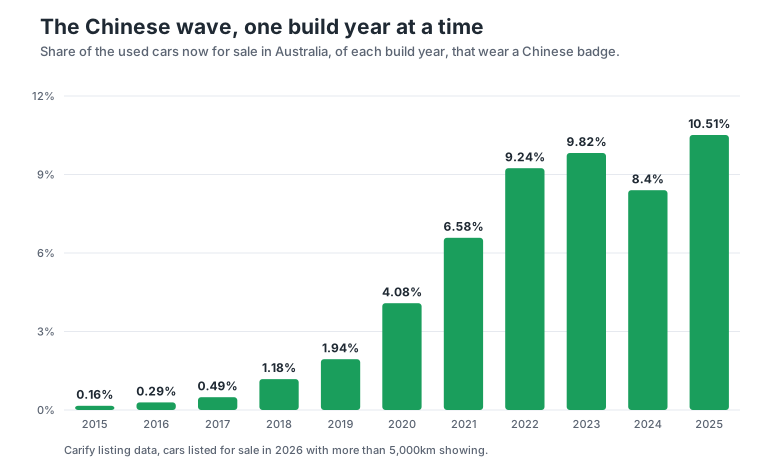
Each of those columns is a cohort working its way toward the second-hand market. The 2022 and 2023 plates are the ones now hitting three years old, coming off finance and out of company fleets, and they are close to one in ten. The one wobble is the 2024 plate, which dips back to 8.4 percent before the trend resumes.
Almost nobody is selling an old one
The second thing the data shows is how new this stock is. The typical Chinese car for sale in Australia right now was built in 2023 and has about 35,000km on it. The typical used car of any badge was built in 2018 and has done 90,000.
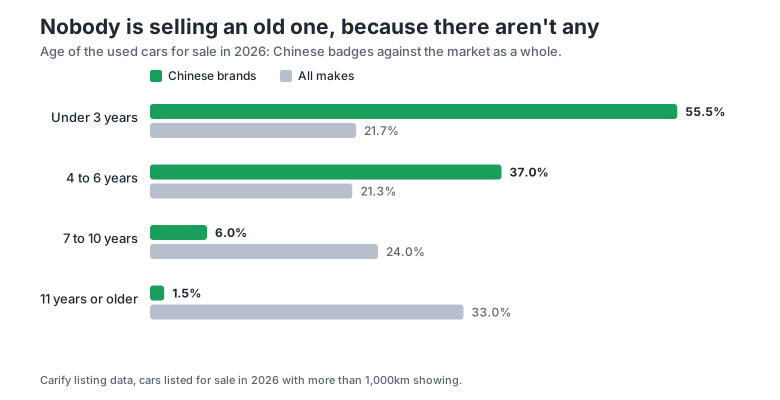
Over half of them are under three years old. Only 7.5 percent have made it past seven, where the market as a whole is 57 percent. If you want a ten-year-old MG or Haval, there is barely a market to shop in, and that shapes what you can actually do with this information. There is no long tail here yet, so nobody, us included, can tell you how one of these cars looks at 200,000km in Australian conditions. That evidence does not exist so far.
Who is selling them is telling too. Around 90 percent of Chinese-badge listings come from dealers and only 6.5 percent from private sellers, against 13.5 percent private for the market overall. Cars this young are still trade-ins, demos and lease returns sitting on a yard, not something a family is selling out the front.
It is MG and GWM's used market, not BYD's
The brands doing the heavy lifting are simply the ones that have been here longest. Great Wall arrived in 2009 as the first Chinese carmaker to sell here, and MG and LDV both landed during the 2010s. That head start is the whole reason they own this list.
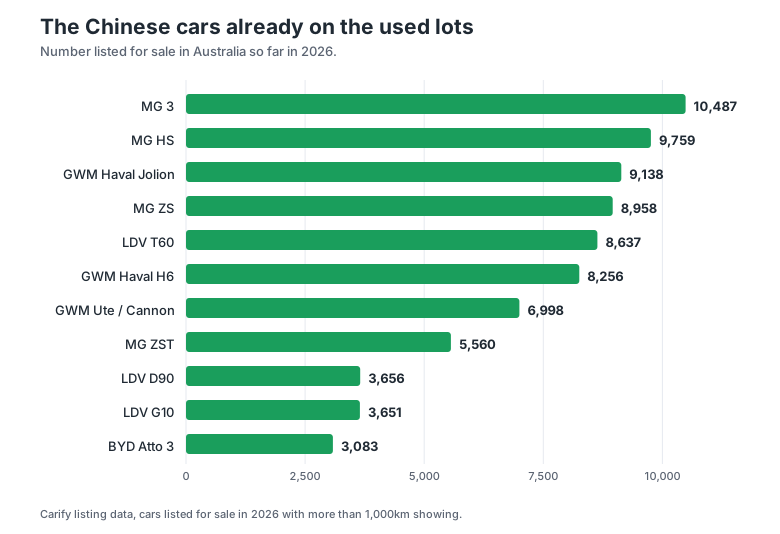
BYD is the brand rewriting the new-car charts and it is nowhere near that list. There have been 11,261 BYDs listed for sale this year, and 97 percent of them are under three years old. The median one was built in 2025, has 7,288km on the clock and is asking $43,006. Those are not used cars in any normal sense. They are demonstrators, cancelled orders and cars flipped inside a year.
One more thing separates this stock from the rest of the lot. Just over 20 percent of Chinese-badged used listings are a hybrid or an EV, against 6.8 percent of the market. For BYD it is 97 percent. If you have been reading about what happens to used EV prices in Australia, a lot of the new supply arriving is going to be exactly this.
What it costs, and what we still don't know
In dollars, a three-year-old Chinese car is cheap, because it was cheap new. A 2023 MG 3 asks a median $15,471 and a 2023 MG ZS $17,888. A Haval Jolion of the same year is $22,689 and an LDV T60 ute $29,941. For comparison, a 2023 Mazda CX-3 asks $25,219 and a Corolla $29,654.
Whether they hold value is the question everyone asks, and our honest answer is that it depends entirely on the model, not the country. Comparing what a three-year-old asks against a near-new one of the same nameplate, the Haval Jolion is one of the strongest performers in the whole market at 95 percent, and the MG ZST is at 93. The MG HS is down at 69, roughly where the Subaru Forester sits. The spread inside the Chinese brands is about as wide as the spread outside them.
Treat those percentages carefully, including ours. That measure compares two used prices, so it moves whenever a brand changes what it charges for a new one, and these brands change their prices constantly. The MG HS looks weak partly because the 2025 car moved upmarket. The Jolion looks strong partly because its price barely moved. Neither number is a forecast of what your car will be worth in 2029.
If you are buying one
The practical upshot is that you are buying into a market with no history. There is no fifteen-year parts and repair track record for a Jolion the way there is for a Corolla, and the resale record runs about five years deep, not fifteen. That is not an argument against the car. It is an argument for judging the individual example harder than you would a known quantity.
Two things matter more than usual here. Because almost all of this stock is nearly new and dealer-held, a lot of it is ex-demo or ex-fleet, so check what the odometer and the history actually say rather than what the age implies. And because these models get updated and repriced so often, check what the current new one costs before you agree a price on a two-year-old one. A Carify report pulls the odometer history, write-off record and any finance owing in one go, and if you want the wider picture on resale first, our data on the cars that hold their value in Australia covers the established nameplates.
How we did this
The figures come from Carify's index of Australian used-car listings, 24 million of them captured since late 2020. "Chinese brand" means a Chinese-owned marque: MG, GWM and Haval, LDV, BYD, Chery and Omoda and Jaecoo, Geely and Zeekr, Deepal, Leapmotor, XPeng, GAC and Aion, JAC and Foton. Chinese-built cars from Western brands, so Teslas and Polestars and the Chinese-made Volvos, are not counted, which makes our figure a conservative one.
Share figures cover listings first seen in each calendar year, with 2026 running to early September. Listings under 1,000km are excluded so new-car ads do not count as used stock, and the build-year chart uses a 5,000km floor to strip out demonstrators. Because our coverage of listing sources has grown over the period, we re-ran the trend across only the sources that were present in every year from 2021 to 2026, and got the same shape, 0.48 percent rising to 4.59. Prices are median asking prices on listings seen in 2026, not sold prices, and every model figure quoted rests on at least 40 listings.