It is a real drop. It is also not the collapse the headlines promised, and it is a long way from the whole story. We went back through Australian used listings from the past twelve months, model by model, and the honest finding is this: electric cars sit a little lower than petrol ones on value kept, and the spread between individual electric models is so wide that knowing a car is electric tells you almost nothing about where it will land.
What a used EV actually keeps
The measure is simple. Take the median asking price of a 2022 build of a model, divide it by the median asking price of a 2025 build of the same model, and you have the share of a near-new car's price that a three-model-year-older one still commands. It is not depreciation from the new price, because once the discounting starts nobody can see the real new price anyway. It is what a seller can ask today.
Across the electric models with enough listings to measure:
- MG ZS EV keeps 80 per cent. A 2022 asks about $24,480 against $30,760 for a 2025.
- BYD Atto 3, 76 per cent: $30,490 against $39,890.
- Tesla Model 3, 70 per cent: $39,333 against $55,989.
- Hyundai Kona Electric, 64 per cent: $31,888 against $49,990.
- Tesla Model Y, 63 per cent: $40,990 against $64,990.
- Hyundai Ioniq 5 is the weakest of them at 56 per cent, $40,339 against $71,990.
Twenty-four percentage points separate the best from the worst. On a $50,000 car that is $12,000, decided by which badge you chose, not by whether you went electric.
The petrol comparison is closer than you would think
Run the same sum on the cars Australians buy in volume and they come out between 66 and 83 per cent. A RAV4 Hybrid keeps 83. A Camry Hybrid and a Mazda 3 sit at 78. A HiLux keeps 73, a CX-5 71, a Corolla 68, a Ranger 67, a Golf 66.
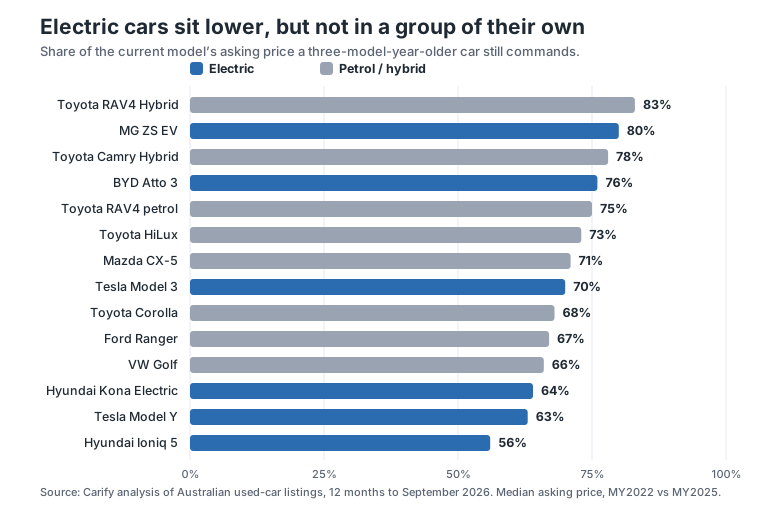
Value kept over three model years. Electric models in blue, petrol and hybrid in grey.
Two things fall out of that chart. The bottom of it is electric, and the three weakest results on the list are all EVs. But the second strongest is electric too, and a Tesla Model 3 lands between a Mazda CX-5 and a Corolla. There is no clean line between the two groups. There is a petrol pack that clusters tightly and a set of EVs scattered from top to bottom, which is exactly what you would expect from a segment where the makers are still finding the price.
The cleanest test we have: the same car, two drivetrains
Comparing a Tesla with a Corolla always leaves room for argument, so the sharper test is a nameplate sold with both a battery and an engine. Two of those have enough Australian listings to read, and they disagree with each other.
The Hyundai Kona goes the way you would guess. The electric one keeps 64 per cent of a current Kona Electric's price, the petrol one keeps 75. Same body, same badge, eleven points apart.
The MG ZS goes the other way, and not by a little. The ZS EV keeps 80 per cent while the petrol ZS keeps 66. The electric version of the cheapest small SUV in the country is holding on better than the engine version of the same car.
If there were a simple electric penalty, those two would point the same direction. They do not.
What actually happened to Tesla
The reason EVs got their reputation is worth spelling out, because it was not really depreciation. Tesla cut the price of a new Model 3 and Model Y in Australia repeatedly through 2023, round after round. When the new price falls by thousands, every used one falls with it, because nobody pays near-new money for a used car they could buy new for less. Owners did nothing wrong and still watched their car lose value overnight, by decision rather than by wear.
CarsGuide put numbers on it, tracking classified listings from January 2023 to December 2024: the average used Model 3 ad went from $65,990 to $46,705, the Model Y from $79,950 to $53,987, the BYD Atto 3 from $51,990 to $36,990. Falls of roughly 30 per cent in under two years, on cars that were only a year or two old.
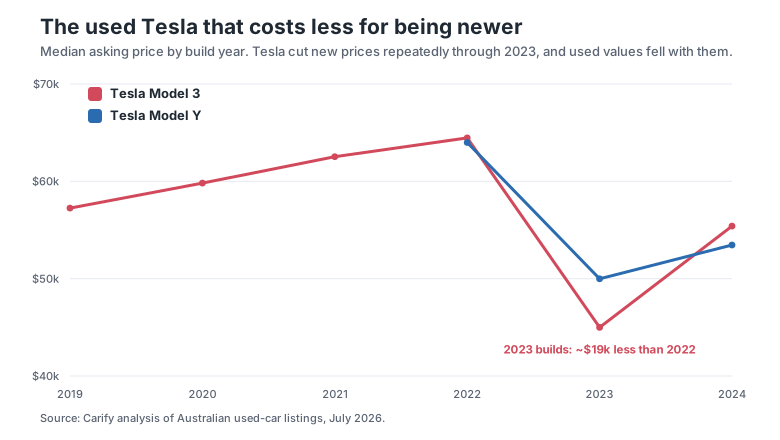
How it looked in the middle of 2026: for a while the 2023 builds sat below the 2022 ones, a newer car for less money.
That inversion has now worked its way out. On the last twelve months of listings a 2022 Model 3 asks about $39,333 and a 2023 asks about $41,980, back in the order you would expect, just at a much lower level than either car started from. The cliff was a one-off correction to a new price, not a permanent feature of electric cars.
Why electric values still move differently
A used petrol car's price is set by supply and demand for that particular car. A used EV's price is set by that plus two things a petrol car never has to think about.
The first is what the maker does to the new price next quarter. Tesla showed it will cut hard and without warning, and the Chinese brands have shown the same willingness. The second is how fast the technology moves. Every model year adds range and takes something off the last one, so a three-year-old EV can feel a generation behind in a way a three-year-old Corolla never does. Add a buyer pool that is smaller and far more price-aware than the petrol market, and prices lurch.
The tax rule that quietly props some of them up
There is a support underneath used EV prices that most buyers miss. Since 1 July 2022 an eligible electric car provided through a novated lease has been exempt from fringe benefits tax, and the exemption is not limited to new cars. Per the ATO, the car has to have been first held and used on or after 1 July 2022, and it must never have been subject to luxury car tax, at its first sale or any sale after it. A used EV that clears both tests can still be salary packaged, which puts a class of buyer in front of it that a petrol equivalent simply does not have.
Two practical consequences. A 2022 or later EV that stayed under the threshold when new is worth more to the right buyer than its screen price suggests, and it is worth checking that history before you negotiate. And plug-in hybrids stopped qualifying on 1 April 2025, so a used PHEV no longer carries that same advantage.
The wave that is coming
All of this matters more each year, because the used EV market has gone from a curiosity to a flood. Around 1,000 electric cars entered the Australian used market in 2020. In 2024 it was more than 34,000, and it is still climbing.
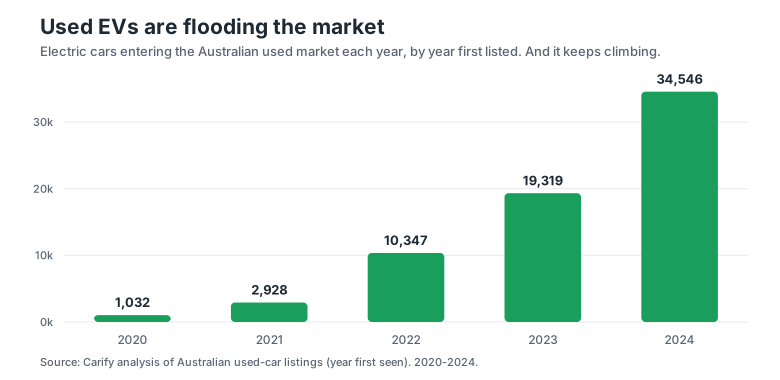
Electric cars entering the used market each year, by the year they were first listed.
A lot of Australians are about to buy a used electric car for the first time, straight into a market that behaves like the chart above. It pays to know the rules before you play.
What to check before you buy one
The volatility is the opportunity. A 2022 Model 3 at $39,000 is a great deal of car for the money, precisely because the first owner already wore the drop. Four things protect you from wearing the next one.
Check what the same car costs new this week. If the maker cuts again, your used one follows it down. This is the single biggest risk on an EV and it takes two minutes to check.
Check the battery warranty, not just the battery. The cover is long and it follows the car, which is the part people miss. Tesla warrants the battery for eight years or 160,000km on the rear-wheel-drive Model 3 and Model Y, and eight years or 192,000km on Long Range and Performance versions, tied to the VIN and transferable to you. BYD covers its traction battery for eight years or 160,000km. MG went further on the 2024 MG4 and ZS EV, at ten years or 250,000km. A 2022 Model 3 therefore still has around four years of battery cover left on it, which changes the risk on the one repair that can cost more than the car.
Then get the battery's state of health read, which is a different thing again. Warranty covers a battery that fails or drops below a threshold. It does not cover one that has quietly lost range on you. The state of health check is the EV version of a compression test, and any decent EV specialist can pull it in minutes.
Check the car's history like any other car. An EV can be a repairable write-off, carry money owing, or have a rolled-back odometer, exactly like a petrol one, and a battery in a car that has been in a serious hit is its own problem. A Carify report covers the write-off, finance and odometer side in one go. If it is your first electric car, our guide to buying a used hybrid or EV walks through the rest, and there is more in our electric vehicles guides.
If you are the one selling
An EV bought new is the most exposed car on the market to somebody else's pricing decision. Price it against what a new one costs this week, not against what you paid. The buyer can see the new price too, and on an electric car they almost always look.
If yours is one of the models near the top of that chart, say so and show the working. And if it qualifies for the novated lease exemption, that is worth stating in the ad, because it widens the pool of people who can afford you.
How we did this
The figures are median asking prices from Carify's analysis of Australian used-car listings, taken from the twelve months to September 2026 so they reflect the market as it is now rather than an average across the years. Value kept is the median for a 2022 build divided by the median for a 2025 build of the same model, which is a comparison of two used prices, not depreciation from a new price. A 2025 build is near-new stock, much of it ex-demo, so treat it as the top of the used market rather than the showroom price. Medians keep outliers from skewing the result, listings under $3,000 and over $300,000 are excluded as data errors, and any model year with too few listings to be stable is left out. Where a nameplate sells with both a battery and an engine we compared it against itself, which controls for brand and class. The Tesla price movement is deliberately not called depreciation, because it was driven mostly by cuts to the new price rather than age or wear.