We went looking for that pattern in our own data. Carify tracks live and recent listings from right across the Australian market, so we pulled the median asking price of every major model by build year, from a set of more than 18 million listings. Line a five to six-year-old example up against a near-new one of the same model and you get a hard number for how well it shrugs off depreciation.
The value-holders are boringly consistent
The strongest performers will surprise nobody who has actually bought a used car here. A 2019 Subaru Forester still asks about 88 percent of what a near-new one does. Mazda's CX-3 and CX-5 sit around 82 to 86 percent, the RAV4 the same, and the Corolla and Camry hold close to 80. Even the Mitsubishi ASX, a car people love to write off, quietly keeps 81 percent.
There is no trick to it. These are Toyota, Mazda and Subaru models with deep buyer demand, cheap parts and a reputation that survives 150,000km. Most of them also sit near the top of our most reliable cars in Australia list, and that is not a coincidence: a car that is easy to live with is easy to sell, and one that is easy to sell holds its price. If resale is anywhere in your thinking, this end of the table is where the safe money sits.
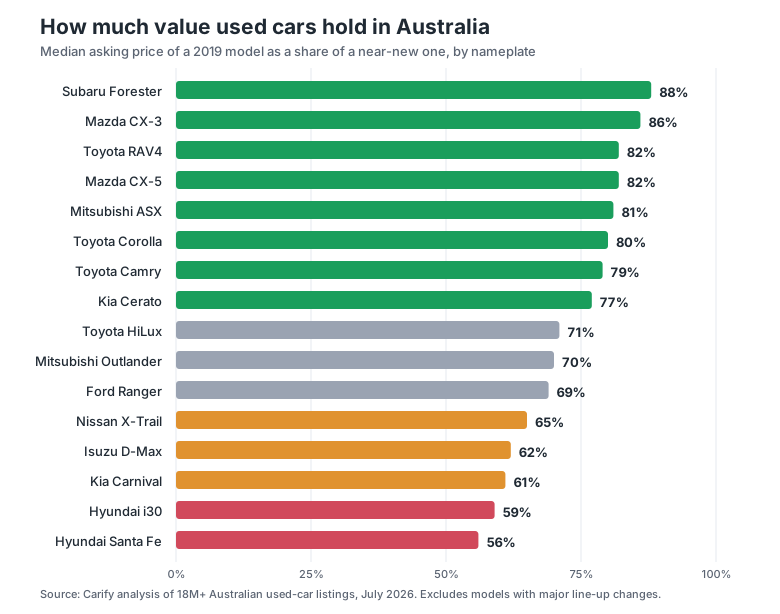
How much of a near-new price a five to six-year-old model still commands, by nameplate.
Utes and hard four-wheel-drives play their own game
Dual-cab utes and proper off-roaders behave differently again. A five-year-old HiLux or Ranger holds roughly 70 percent of near-new money, which sounds ordinary until you notice that near-new has itself become very expensive. The median near-new Ranger now sits around $66,000, up about 45 percent on where a 2019 one landed. Utes did not get cheaper to own, the whole ladder just moved up.
The LandCruiser is the outlier that proves the rule. A 2015 example, now a decade old, still asks around $54,000. It barely depreciates because supply is tight and the people who want one really want one. The Prado and the Nissan Patrol do much the same thing. Buy the right four-wheel-drive well and the cost of a few years' ownership can be surprisingly close to nothing once you sell.
Where the money quietly disappears
At the other end, large family SUVs and a run of once-cheap hatches fall hardest. A five-year-old Hyundai Tucson, i30 or Kona, a Kia Sorento or a Santa Fe, holds somewhere between 56 and 60 percent of a near-new one.
Read that carefully, because the raw figure flatters the wrong conclusion. A big part of the fall is that Hyundai and Kia moved sharply upmarket. Their new cars cost far more than they did in 2019, so an older one looks cheap by comparison. The old car did not implode, the new one got dear. Either way the message for your wallet is the same: buy one of these new and sell in five years and you hand back more of your money than a Toyota owner does. People movers are blunter still. The Kia Carnival, as genuinely useful as it is, keeps only about 61 percent, because a high-kilometre family bus is a hard private sell.
You can see the split inside a single segment. Put three mid-size SUVs that cost about the same new side by side and the lines fan apart with age.
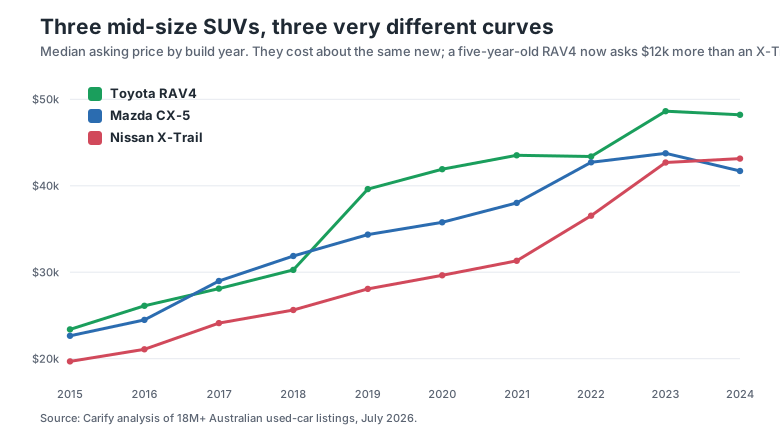
Three mid-size SUVs priced similarly when new. The RAV4 and CX-5 stay high; the X-Trail sits well below.
The European hatch trap
The Volkswagen Golf deserves a warning, though not the obvious one. On paper it looks like one of the worst value-holders in the market. The reality is messier. Volkswagen quietly dropped the affordable Golf from Australia, so a new one today is almost always a $55,000-plus Golf R or GTI. Measure that against a modest 2019 Golf and the ordinary car looks like it collapsed when it did not. The real lesson is subtler: European hatches and small cars have thin used demand here, pricey out-of-warranty repairs, and buyers who know it. Lovely to drive, costly to let go.
The electric wildcard
Electric cars break every rule in this analysis, and it is worth understanding why before you buy one used. On a straight reading, a 2019 Tesla Model 3 asks slightly more than a 2024 one, which would suggest electric cars never depreciate. They depreciate viciously. What actually happened is that Tesla cut the price of a new Model 3 by tens of thousands of dollars across 2022 and 2023, and every used one got dragged down with it. In our listings the median 2022 Model 3 sat around $64,000, and 2023 cars around $45,000 within a year of each other.
That is the whole used-EV story right now. Values are hostage to whatever the maker does to new prices next quarter, and to battery-warranty nerves. There are real bargains in used EVs precisely because of this, but go in knowing the floor can move under you.
What to do with all this
If you are buying and you care about resale, the pattern is clear enough to act on. A mainstream Japanese small SUV or a well-bought ute will hand back most of your money. A big family SUV, a people mover or a used EV will cost you more to own than the drive-away price suggests, sometimes a lot more, even when the deal looks sharp.
If you are selling, price against the model, not the mileage. A Forester and a Golf of the same age and kilometres are not in the same market, and pretending otherwise just leaves your car sitting in the driveway. A few small things genuinely lift resale, but the badge on the bootlid does most of the work.
Whichever side you are on, the averages here describe the model, not the specific car in front of you. A rough history, a rolled-back odometer or a repairable write-off will sink an individual car well below its model's curve, and none of it shows up in the ad. A Carify report tells you which car you are actually looking at before you hand over the money.
How we did this
The figures are median asking prices from more than 18 million Australian used-car listings tracked by Carify, grouped by build year. "Value kept" compares a 2019 model against a near-new example of the same model in the current market, so it measures resale strength across the market rather than the depreciation of any one car. We used medians to keep salvage and mispriced listings from skewing the numbers, and we left out models whose line-up changed so much between 2019 and today, such as the Golf and the Yaris, that the comparison stops being like for like.